Flight compensation in Europe vs. the U.S.: when an airline owes you money
Compare EU, UK and U.S. rights to cash compensation, refunds, meals and hotels after delays, cancellations and overbooking.
Start with what the airline owes you#
A canceled flight can leave you with three separate questions: Will the airline return your ticket money? Must it cover food and a hotel? Does it owe you an extra cash payment for the disruption?
The answers differ sharply across the Atlantic. On qualifying European flights, a long arrival delay or a short-notice cancellation can trigger fixed compensation. In the United States, an ordinary delay or cancellation generally does not create that same cash entitlement. You may still have a firm right to a refund, and the airline may owe help under its own service commitments. The European Commission's passenger guide and the U.S. Department of Transportation's Fly Rights guide explain these different systems.
This guide covers flight delays, cancellations and denied boarding. Baggage, injuries and package holidays have separate rules. Rules and official guidance were checked November 6, 2026.
| What you are asking for | Qualifying EU flight | Flight under U.S. rules |
|---|---|---|
| Extra cash for a long delay | Possible, subject to conditions | No general federal fixed payment |
| Ticket refund after cancellation | Choice of refund or rerouting | Refund if you decline alternatives |
| Meals and an overnight hotel | Statutory care where due | Depends on airline commitments |
| Payment for an oversold seat | Fixed compensation may apply | Fare-based compensation may apply |
Sources: EU Regulation 261/2004, Articles 4–9, DOT refund rules, DOT service dashboard and DOT denied-boarding guidance. These are different remedies; a refund returns the price paid, while compensation is an additional payment.
Europe: your route and operating airline come first#
Europe is not one legal jurisdiction. The EU framework generally covers departures from an EU airport on any airline. For a flight from outside the EU into the EU, the operating airline generally must be an EU carrier. The Commission also identifies Iceland, Norway and Switzerland within the wider framework; check the relevant national authority for local application. The UK has its own system, explained below. Source: Your Europe.
For a simple nonstop itinerary, consider these hypothetical examples:
| Flight | Operating airline | EU261 coverage |
|---|---|---|
| Paris to New York | A U.S. airline | Generally yes |
| New York to Paris | A U.S. airline | Generally no |
| New York to Paris | An EU airline | Generally yes |
These examples apply Article 3's route and carrier test; coverage alone does not prove a payment is due. Look for “operated by” on your booking. A codeshare flight number or the program that issued your award does not, by itself, identify the airline responsible. Connections and remedies already received under another country's law can affect a claim.
When EU cash compensation is due#
For a qualifying delayed journey, the usual starting point is arrival at the final destination at least three hours late, unless the airline proves an applicable extraordinary-circumstances defense. A late departure that still arrives less than three hours late is a different case. For protected connections, assess the final destination and the booking structure. Source: Commission delay guidance.
The basic compensation bands come from Article 7 of EU261:
| Flight distance or category | Basic amount per person |
|---|---|
| Up to 1,500 km | €250 |
| Within the EU over 1,500 km; other flights over 1,500 to 3,500 km | €400 |
| Other flights over 3,500 km | €600 |
These are fixed amounts, not percentages of the ticket price. Reductions matter: for the long-haul €600 category, an eligible arrival delay of at least three but less than four hours normally means €300. Rerouted passengers can also face a 50% reduction when arrival falls within the applicable two-, three- or four-hour window. The Commission publishes the detailed reduced-payment tables.
For cancellations, compensation is generally in play when notice arrives less than 14 days before departure. But a replacement flight close enough to the original schedule can remove the entitlement:
| Cancellation notice | Rerouting that avoids compensation |
|---|---|
| At least 14 days | Advance notice itself removes this compensation entitlement |
| 7 to less than 14 days | Leave no more than 2 hours early; arrive less than 4 hours late |
| Less than 7 days | Leave no more than 1 hour early; arrive less than 2 hours late |
Both timing conditions in the relevant rerouting row must be met. The airline can also avoid this payment if it proves extraordinary circumstances that could not have been avoided with all reasonable measures. These cancellation tests are set out in Article 5.
Severe weather, security risks and some air traffic restrictions may qualify. Most routine technical faults and an airline's own staff strikes generally do not. An “operational reasons” message is too vague to assess on its own: ask what happened and how it caused your disruption. The Commission's guidance explains the airline's burden of proof.
Meals, hotels and refunds are separate EU rights#
An extraordinary event can defeat cash compensation while leaving care rights intact. For departure delays, meals, refreshments and communication become due after the relevant waiting period:
| Flight category | Delay that triggers care |
|---|---|
| Up to 1,500 km | 2 hours |
| Within the EU over 1,500 km; other flights over 1,500 to 3,500 km | 3 hours |
| Remaining flights over 3,500 km | 4 hours |
Where an overnight stay becomes necessary while you wait, care can include accommodation and transport. Ask the airline to arrange it first. Keep receipts for reasonable expenses if it fails to help. The Commission's passenger-rights leaflet explains these thresholds and the separate right to care.
After a cancellation, you generally choose a refund, rerouting at the earliest opportunity, or later travel under comparable conditions subject to seat availability. At a departure delay of at least five hours, you can abandon the journey and claim the applicable ticket refund. A return to your starting point can also be due if the trip no longer serves its purpose. Choosing a refund ends the ongoing care obligation. Any cash compensation that is separately due still needs assessment. Sources: EU261 Articles 6–9 and the Commission leaflet.
The UK uses pounds and its own coverage rules#
UK protection generally covers departures from the UK on any airline, arrivals in the UK on a UK or EU airline, and arrivals in the EU on a UK airline. The Civil Aviation Authority's coverage guide explains the scope.
For eligible arrival delays, the UK uses these pound amounts:
| Distance | Arrival delay | Amount per person |
|---|---|---|
| Up to 1,500 km | At least 3 hours | £220 |
| Over 1,500 to 3,500 km | At least 3 hours | £350 |
| Over 3,500 km | 3–4 hours | £260 |
| Over 3,500 km | More than 4 hours | £520 |
The cause and other conditions still matter. Use the CAA's delay guidance rather than converting a euro figure at today's exchange rate. EU and UK coverage can overlap, but do not assume you can collect twice for the same disruption.
United States: know when you can take your money back#
On scheduled flights to, from or within the United States, a cancellation or significant change can entitle you to a refund even on a nonrefundable ticket. You must decline the changed flight, replacement travel and alternatives such as vouchers. You cannot use the replacement journey and also demand a full ticket refund under that rule. Source: 14 CFR 260.6.
DOT's significant-change tests include:
| Schedule change | Domestic itinerary | International itinerary |
|---|---|---|
| Earlier departure | At least 3 hours earlier | At least 6 hours earlier |
| Later arrival | At least 3 hours later | At least 6 hours later |
Different origin or destination airports, added connections, a downgrade and certain accessibility changes can also qualify. A cancellation does not need to pass the three- or six-hour test. Refund rights apply regardless of why the airline canceled or significantly changed the flight, including weather. Source: DOT refunds guidance.
If you reject the alternative, DOT says refunds are due within seven business days for credit card payments or 20 calendar days for other payments. An airline booking can qualify for an automatic refund; if an agent took the payment, contact that agent about the refund. Do not accept a credit merely because it appears first in the app. Source: DOT refund options and timing.
Continuing to travel after a U.S. delay generally leaves you without a federal fixed cash award for lost time. Airline promises can still matter. Check the DOT cancellation and delay dashboard for meal, hotel and rebooking commitments during disruptions within the carrier's control. DOT can enforce those promises; the same commitments may not cover weather. Ask before paying for a replacement ticket yourself.
For some international journeys, the Montreal Convention provides a separate route to claim proven losses caused by delay, subject to its conditions and defenses. That is not an automatic EU-style payment. DOT's Fly Rights guide describes this distinction.
Oversold flights are an important U.S. exception#
If an airline involuntarily bumps you from an oversold flight departing a U.S. airport, cash compensation can be due. You generally need a confirmed booking, timely check-in and timely arrival at the gate. The calculation uses the one-way fare and the arrival delay of substitute transport:
| Scheduled arrival delay | Domestic flight | International flight leaving the U.S. |
|---|---|---|
| Up to 1 hour | No payment required | No payment required |
| More than 1 to 2 hours | 200% of fare; cap $1,075 | 200% of fare; cap $1,075 |
| More than 2 to 4 hours | 400% of fare; cap $2,150 | 200% of fare; cap $1,075 |
| More than 4 hours | 400% of fare; cap $2,150 | 400% of fare; cap $2,150 |
These are regulatory minimum calculations with permitted caps, not promises of the maximum. If no substitute transport is arranged, the 400% calculation applies. Exceptions include certain aircraft substitutions, small aircraft and safety-related weight restrictions. Flights into the U.S. from abroad do not fall under this U.S. denied-boarding regime. If you volunteer, negotiate the offer and restrictions before agreeing; that is a different arrangement. Sources: DOT bumping and oversales guidance and DOT Fly Rights.
Miles bookings still deserve a claim check#
EU261 expressly includes tickets issued through frequent flyer programs. In the U.S., an eligible involuntary denied-boarding claim on an award ticket uses the lowest paid fare in the same class on that flight when the ticket shows no fare. Paying with points does not make these rights disappear. Sources: EU261 Article 3 and DOT Fly Rights.
Our guide to Compensair and award-flight claims explains how to compare a direct claim with paid help. Also keep airline disruption rights separate from deciding to cancel a trip yourself: our British Airways reward-cancellation guide covers that different decision.
Build the claim around the remedy#
Save the booking, boarding pass, original schedule, airline notices, actual arrival details and receipts. Ask for the cause in writing. Identify whether you want a ticket refund, expense reimbursement or statutory compensation, and keep the amounts separate.
- IdentifyRecord the route and operating airline
- DocumentSave schedules, messages, arrival details and receipts
- ChooseDecide whether to accept rerouting or take a refund
- ClaimState each remedy and its evidence separately
- EscalateUse the relevant regulator or dispute process if unresolved
For EU claims, complain to the airline first, then use the Commission's redress guidance to identify the appropriate next step. For UK claims, the CAA explains escalation to an airline's dispute provider or its own complaints team. For U.S. problems, the DOT dashboard links to its complaint process.
Claim promptly and check the deadline for your jurisdiction. The EU's newly adopted Regulation 2026/2202 applies from October 23, 2027. Its future procedures should not be treated as rules already governing a November 2026 disruption.
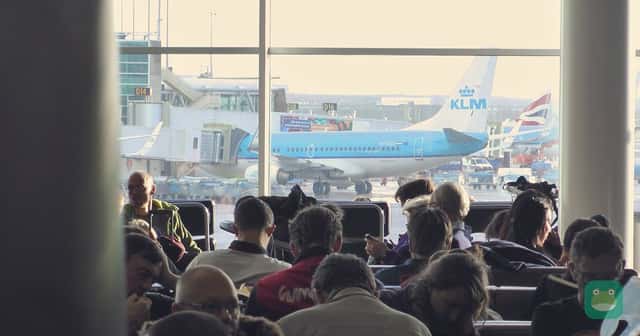
Photo: Steven Lek, “Waiting room Schiphol Airport,” December 6, 2013, via Wikimedia Commons, CC BY-SA 4.0. Cropped for publication; the adapted photograph is shared under the same license. Representative airport scene, not a documented delay.

Cite this article
Points Frog (AI-assisted). “Flight compensation in Europe vs. the U.S.: when an airline owes you money.” Points Frog. Published 2026-11-06. https://www.pointsfrog.com/news/flight-compensation-europe-vs-united-states-passenger-rights
Wikipedia citation
{{cite news |title=Flight compensation in Europe vs. the U.S.: when an airline owes you money |url=https://www.pointsfrog.com/news/flight-compensation-europe-vs-united-states-passenger-rights |work=Points Frog |author=Points Frog (AI-assisted) |date=2026-11-06 |language=en}}CSL-JSON for reference managers
{
  "id": "https://www.pointsfrog.com/news/flight-compensation-europe-vs-united-states-passenger-rights",
  "type": "article-newspaper",
  "title": "Flight compensation in Europe vs. the U.S.: when an airline owes you money",
  "URL": "https://www.pointsfrog.com/news/flight-compensation-europe-vs-united-states-passenger-rights",
  "container-title": "Points Frog",
  "language": "en",
  "author": [
    {
      "literal": "Points Frog (AI-assisted)"
    }
  ],
  "issued": {
    "date-parts": [
      [
        2026,
        11,
        6
      ]
    ]
  }
}Citations identify this article and its publication date. Assess the reporting and its linked sources before using it as evidence.